【 XR INDUSTRY EVENT 】Kaohsiung VR FILM LAB Originals Showcase
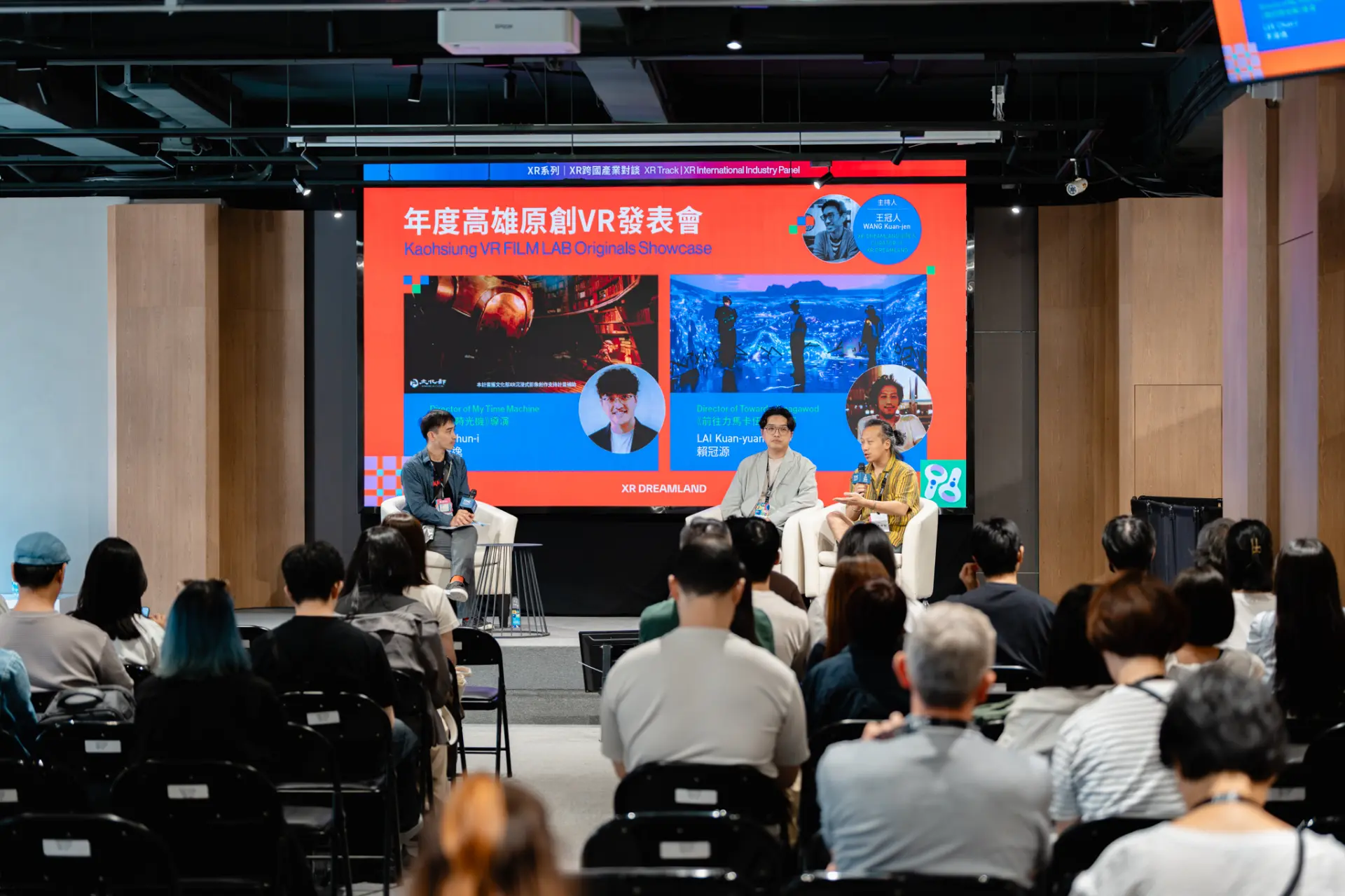
.Panelists
- Director of My Time Machine|LEE Chun-i
- Director of Towards Jimagawod|LAI Kuan-yuan
.Moderator
Curator of XR DREAMLAND|WANG Kuan-jen
____________________________________________________________________
Launched in 2017, the Kaohsiung VR FILM LAB Originals project supports creators in developing VR works through an annual open call, granting them roughly a year of production time. This year’s showcase invited two directors to share their creative visions and production journeys, spanning from free exploration to collective reading experiences, while exchanging insights on leveraging diverse media to explore the possibilities in immersive storytelling.
My Time Machine|Director LEE Chun-i
My Time Machine centers on a young boy who dreams of building a time machine and spends years buried in his silo trying to construct one. However, when he finally arrives in the future, he is left uncertain whether his machine actually succeeded or if time simply slipped away. Originating from a script completed in 2014, the director initially envisioned presenting the story through traditional animation. Yet after discovering VR, he realized that unlike pre-determined animated storyboards, VR allows audiences to choose their own vantage points, fostering nuanced interpretations while better conveying how the story’s space changes over time.
Utilizing 6DoF technology, the work enables viewers to move freely through virtual space, explore environments, and piece together the narrative independently. Beyond visual freedom, sound plays a pivotal role. Seeking to guide audiences without forcing movement, the team meticulously crafted sound cues—such as a mother calling from outside the door, explosions, and barking dogs—to naturally guide viewers out of the boy's silo. Furthermore, as the piece features no dialogue, the musical score was carefully designed to heighten subtle emotional shifts across scenes.
Addressing the core theme, the director hopes audiences reflect not only on whether the protagonist succeeded in building the time machine, but also on what they themselves might have missed in pursuit of their own ideals. While viewers may inevitably miss details in other areas when focusing on specific elements, the director considers this act of "missing out" an integral aspect of the experience. If this prompts reflection on personal loss, viewers might just slow down and notice the changes happening around them when they return to everyday life.
Towards Jimagawod|Director LAI Kuan-yuan
Adapted from Black Wings, the debut novel by Taiwanese Indigenous Yami/Tao writer Syaman Rapongan, Towards Jimagawod draws on an early section of the novel depicting flying fish migration. By combining speech recognition technology with MR projection, the project translates the expressive power of the written text into a shared, collective reading experience.
Director Lai was deeply moved by the novel's evocative depictions of the ocean. He noted that as an island nation, Taiwan possesses a rich seafood culinary culture yet has relatively limited knowledge of the ocean. Named after "Jimagawod"—the Tao word for Little Orchid Island—the piece leverages technology to guide audiences into the world of the novel, allowing them to experience the tribe's respect for flying fish and the sea while encouraging them to rediscover this often-overlooked ocean culture.
"Reading" is at the core of the experience. The director views reading text as an inherently immersive act, where every reader forms a unique narrative landscape in their mind. To bring this expressive quality into VR, the experience invites viewers to read aloud from the outset. Wearing headsets, participants view text and the projections, while AI speech recognition causes the text to change as they read aloud. Real-time audio recordings of their voices are played back within the physical space. As these voices layer over time, solitary reading evolves into a collective experience, bringing participants together through their different imaginings.
Reflecting on the relationship between creative intent and medium, the director emphasized that the spirit of the piece centers on audience participation and the changes that arise organically during the experience. Looking ahead, he hopes to adapt the work for diverse spaces such as bookstores or spherical venues, or develop a single-user MR experience to continue exploring new ways of presenting the work in different spaces